Dog’s Fractured Skull Repaired after Being Kicked by Horse
“Case of the Month” – September 2026
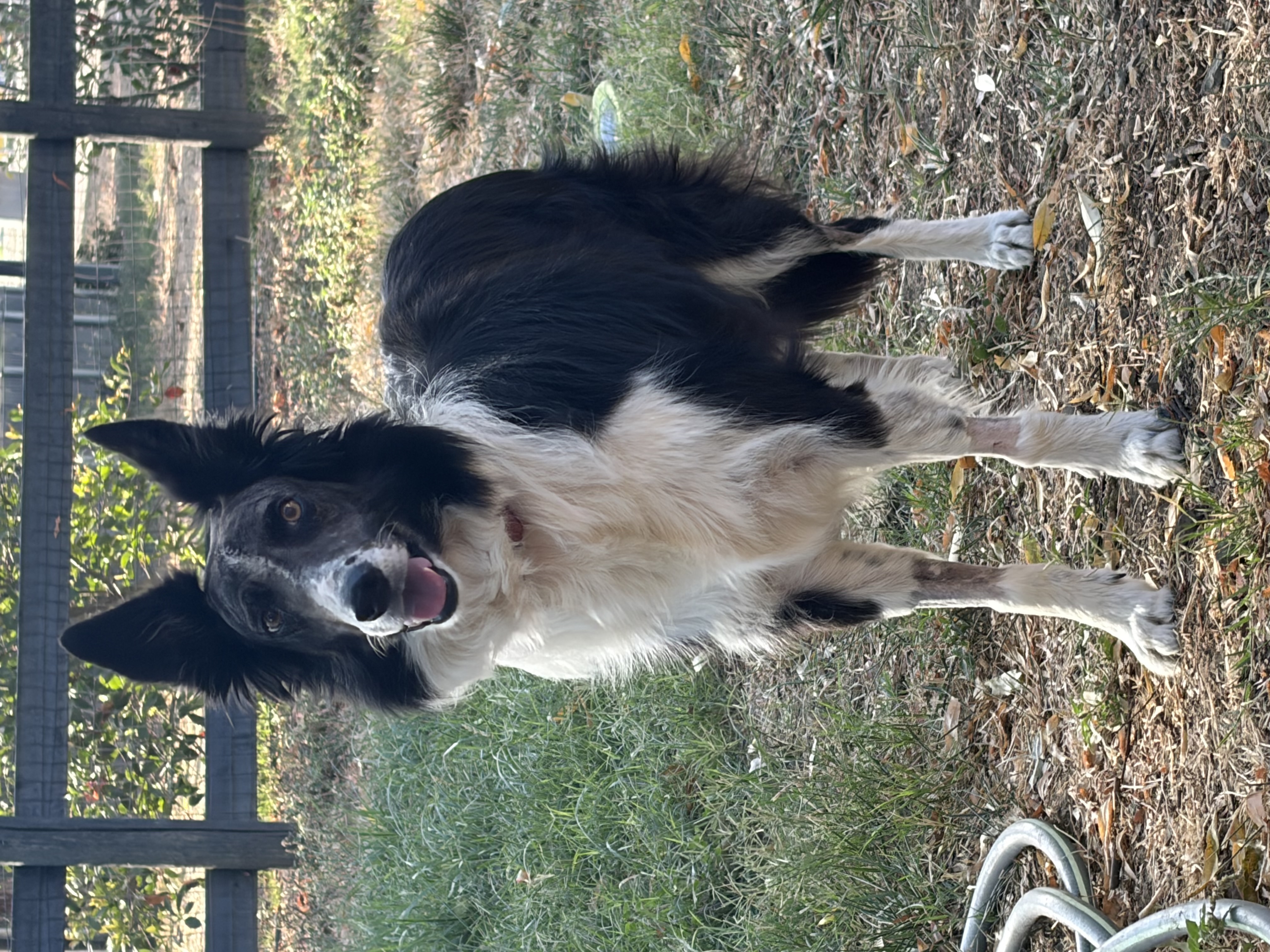
“To look at her now, you wouldn’t think anything happened to her,” exclaimed Andrea Barbee owner of Tessa, a 5-year-old border collie who was kicked in the head by a horse.
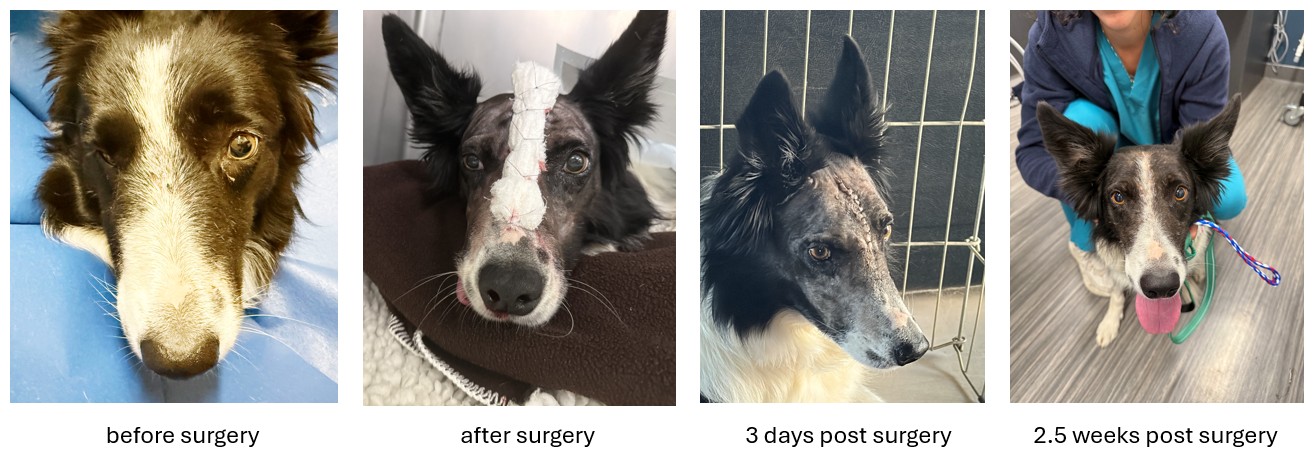
But that certainly was not the case when Tessa arrived at the UC Davis William R. Pritchard Veterinary Medical Teaching Hospital (VMTH) an hour after the accident. She was immediately admitted to the Emergency Room where veterinarians and technicians noted facial swelling on her right side, her right eyeball sunken, her nose bleeding, and palpable fractures of the temporal and mid-face regions.
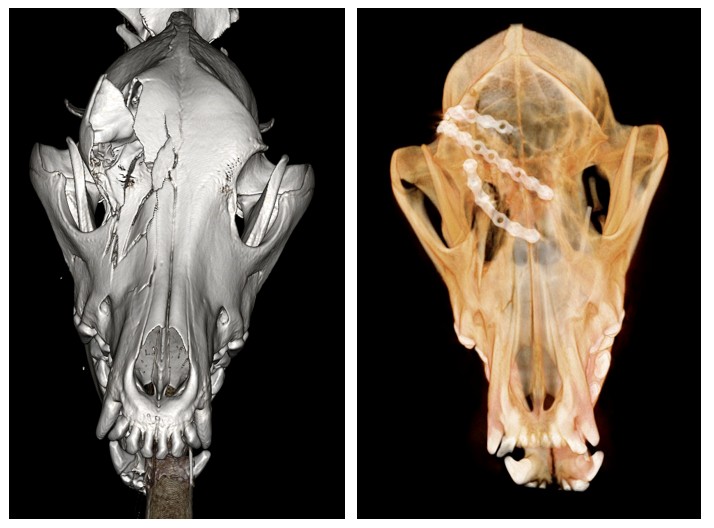
Following stabilization and consultation with the Dentistry and Oral Surgery, Neurology, and Ophthalmology Services, a CT scan confirmed multiple fractures of the right temporal, orbital, nasal, maxillary, and mid-face bones, as well as hemorrhage of her nasal sinuses.
Dr. Boaz Arzi, chief of the Dentistry and Oral Surgery Service (DOSS), along with oral medicine (OM) fellow Dr. Serena Bonacini and oral and maxillofacial surgery fellow (OMFS) Dr. Ingrid Tundo, performed the delicate surgery to correct Tessa’s maxillofacial injuries.
“Tessa sustained some of the most extensive facial injuries we see,” said Dr. Arzi. “The bones on the side of the skull were shattered and shifted so far out of place that the eye shifted out of its normal position, and the bones around the eye were fractured as well. We were able to reconstruct the fractures to the skull’s original form allowing immediate function of the skull and eye.”
OM and OMFS are sub-specialties of DOSS, and Dr. Arzi is a Founding OMFS Fellow of the American Veterinary Dental College (AVDC), as well as leading the oral and maxillofacial trauma and temporomandibular joint repair sections of DOSS. UC Davis is one of only a handful of OM/OMFS Fellowship training sites, offering fellowships since 2020 (OMFS) and 2026 (OM). Additionally, faculty member Dr. Stephanie Goldschmidt is also an OMFS Fellow leading the DOSS surgical oncology section. To achieve the advanced training Fellow status, veterinarians must complete an approved two-year fellowship training program and be diplomates (board certified) of either the AVDC or the European Veterinary Dental College.
Repairing Tessa’s fractures required three titanium miniplates and 16 screws to stabilize the affected bones. She remained stable throughout surgery and recovered from anesthesia normally. At the end of the fracture reconstruction, while still in the operating room, ophthalmology faculty member Dr. Soohyun Kim and ophthalmology resident Dr. George Thelwell examined Tessa’s eyes to ensure correct placement and function. A postoperative cone beam CT scan confirmed successful placement of the plates and screws to effectively reduce the fractures and restore normal orbital positioning. Following a night of hospitalization, Tessa was eating comfortably the next morning and was discharged home.
Barbee brought Tessa back to the VMTH three days after surgery for removal of a stent bandage on her face. This specialized dressing is used after maxillofacial surgery to protect the surgical site and minimize postoperative swelling and air under the skin. Traditional bandaging cannot be wrapped around a dog’s face and jaw, so veterinarians secure a stent bandage by placing suture loops into the intact skin around the incision, then lacing a sterile dressing tightly over the wound.
At a two-week recheck evaluation, Barbee reported that Tessa was having an excellent recovery at home, with no signs of pain or discomfort.
“She kept coming to me with her Frisbee trying to tell me that she was ready to play again,” said Barbee.
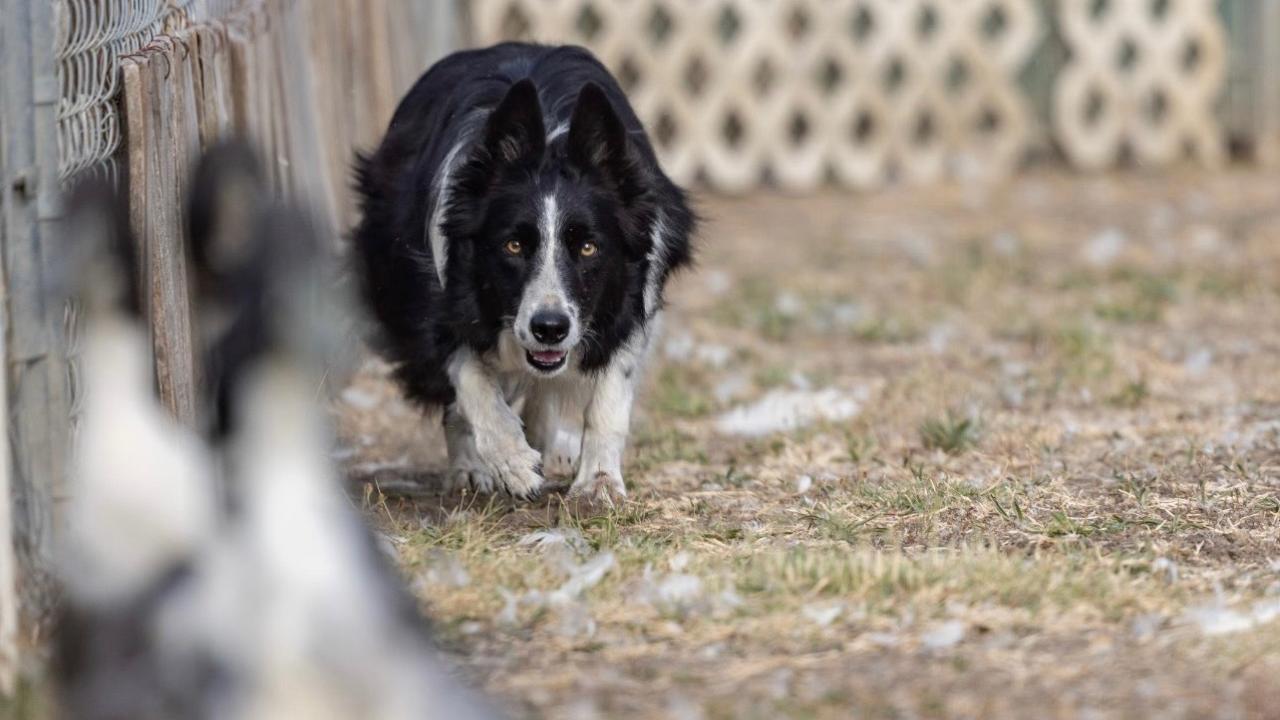
She’s been given that green light now and is enjoying her trialing competitions with Barbee, herding sheep, ducks, and geese. Barbee is thankful she’ll have many more competitions with Tessa to look forward to in her retirement. For now, she and Tessa get plenty of activity on her 60-acre Dreamland Farms with several hunter/jumper show horses, 100 chickens, many koi fish, nine ducks, and one sheep.
“The teamwork at UC Davis was absolutely amazing,” stated Barbee, who has been bringing her animals to the VMTH for 41 years. “Every time I think about how well they treated Tessa, I start crying. They did such an amazing job.”
Tessa will return to the VMTH in about three months for a follow-up CT scan to assess plate positioning and healing of her fractures. Her care team expects a full recovery.
# # #