Drs. Jannah Pye and Tom Cullen, equine surgery residents at the UC Davis veterinary hospital, were recently awarded the Mark S. Bloomberg Memorial Resident Research Award by the Veterinary Orthopedic Society (VOS). The two were among a handful of residents throughout the country award the prize. They were recognized in February at the VOS Annual Conference in Sun Valley, Idaho, before the COVID-19 pandemic caused all veterinary conferences to cease in-person activities.
Cooper, a 16-year-old quarter horse gelding, was brought to the UC Davis veterinary hospital after his owner, Robyn Armstrong, noticed spooking behavior over the past few months. Her normally friendly horse was not letting her near him. The hospital’s ophthalmologists noticed an obstruction in Cooper’s vision, but also noticed an unrelated abnormality on his face. The two separate conditions initially concerned Armstrong and set Cooper back a few months, but ultimately, he emerged a much healthier, happier horse.
Dr. Bret McNabb has been appointed as director of the Large Animal Clinic at the UC Davis Veterinary Medical Teaching Hospital, effective April 1, 2020 for a five-year term.
Fred, a 10-year-old Holsteiner gelding, had a successful 2019 show season in three-day eventing at the “preliminary” level. With the goal of moving up to the “intermediate” and then the “advanced” levels next season, Fred’s owner proactively sought to have him evaluated by the specialists in the Equine Integrative Sports Medicine Service at the UC Davis veterinary hospital.
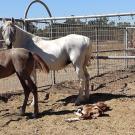
Meringue, a 23-year-old Davenport Arabian mare, was found with her head stuck in her stall door. Her owner, Michael Bowling, had to use fence cutters to open the gate. Once her head was freed from the gate, Meringue went down on her right side and was unable to get up. Bowling, a UC Davis veterinary hospital client for nearly 40 years, called the Equine Field Service, which immediately dispatched veterinarians and a team of veterinary students to his ranch.
Dr. Mathieu Spriet, an associate professor in the Department of Surgical and Radiological Sciences, recently passed boarding examinations to become a founding member of the American College of Veterinary Radiology’s (ACVR) new subspecialty of Equine Diagnostic Imaging.
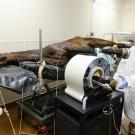
The UC Davis School of Veterinary Medicine, in collaboration with LONGMILE Veterinary Imaging, has completed the first phase of the validation of the MILE-PET, the first positron emission tomography (PET) scanner specifically designed to image the limbs of standing horses, using light sedation, eliminating the need for anesthesia.
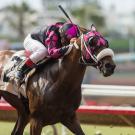
DVM grad Ferrin Peterson, Class of 2019, is also a professional jockey. She has spent much of her adult life traveling the world to see firsthand how training and veterinary practices vary around the world. She penned an open letter to Senator Dianne Feinstein to consider the steps that have been taken to improve racing safety.
A KQED reporter and photographer shadowed the Veterinary Emergency Response Team at the Sonoma County fairgrounds as they cared for animals impacted by the Kincade Fire.
With a goal of bringing imaging technology directly to the racetrack, UC Davis veterinary researchers are helping the horse racing industry to better detect and understand injuries, and ultimately prevent future catastrophic breakdowns. The technology being utilized by the UC Davis School of Veterinary Medicine is positron imaging tomography (PET), and its development continues to make major progress toward early detection of racehorse injuries.