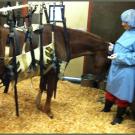
Holly, a 23-year-old American Quarter Horse gelding, was found in his paddock lame on the right front forelimb with a wound over his elbow. The UC Davis veterinary hospital’s Equine Field Service was quickly dispatched to the ranch, and radiographs taken there revealed a fracture of the right olecranon – the curved top of the ulna in the elbow joint.
Equine herpesvirus-1 (EHV-1) is relatively widespread in horses; approximately 60 percent of healthy horses harbor the virus. While the more common form of EHV-1 can cause respiratory illness as well as abortion, it is rarely fatal. However, a neurological strain of this virus, also known as equine herpes myeloencephalopathy (EHM), can kill 30 to 50 percent of affected horses. That's why it is critical for the California Animal Health & Food Safety Laboratory to be able to use PCR testing to differentiate between strains.
Researchers have good news for owners selling or managing horses with ostoechondral fragments (OCF) in the hock: A recent study has confirmed that arthroscopic osteochondral fragment removal in horses’ tarsocrural joints via arthroscopy is efficient, quick, and has few postoperative complications.
Thoroughbred racehorses who suffer catastrophic musculoskeletal injuries are more likely to show lameness in the three months leading up to their injury than horses that race without incident, research has shown.
Southern Phantom’s face is entirely white, with mismatched blue and brown eyes. The short answer to why is his coat like that, there is likely a mutation in one or more of the genes involved in pigmentation.
Surgical and medical treatment for sand accumulations in horses is likely to end well. Radiography is one of the only ways to objectively measure the condition.
For more than 50 years, Michael Muir (yes, the great-grandson of conservationist John Muir) has been breeding horses with the help of the UC Davis veterinary hospital’s Equine Field Service and Equine Reproduction Service. His unique breed of the Stonewall Sporthorse wins national and international competitions--as well as the hearts of those who find a new lease on life from the therapy they provide.
Have you ever wondered where police horses end up when they retire? Most are adopted out to private sanctuaries or rescue organizations, often times being visited by their former partners. The T.S. & K.D. Glide Foundation on the outskirts of Davis houses eight of them.
Dr. Susan Stover has been funded frequently by Grayson-Jockey Club Research Foundation. Her goal in recent research is the prevention of musculoskeletal injuries in equine athletes.
A somewhat mysterious, sometimes fatal muscle-related disease in Quarter Horses is getting a little clearer. Researchers recently determined that immune-mediated myositis (IMM) is due to a genetic mutation encoding a protein that’s expressed in adult equine muscle.