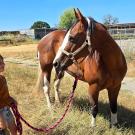
Two years ago, Brandon and Lisa Bacon were looking to purchase a horse for their 12-year-old son Jackson. Through their contacts as the owners of a horse supply company in Northern California, they discovered Ricky, a then 13-year-old American Quarter Horse gelding.
“Jackson has big ‘Gold Buckle’ dreams,” Lisa said. “We’re so proud of how hard he works at this, and we were thrilled to find Ricky, who was already an experienced roping horse.”
An extremely specialized equine surgery performed by only about a dozen veterinarians nationwide is now available at UC Davis. Thanks to the addition of Dr. Carter Judy to the faculty, as well as a dedicated large bore equine CT scanner, the UC Davis William R. Pritchard Veterinary Medical Teaching Hospital (VMTH) now offers foraminotomy surgery for horses with cervical foraminal stenosis—a narrowing of an intervertebral opening where the limb nerve root exits the spinal column.
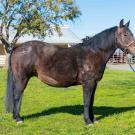
Four years ago, Joe Juice, a then 15-year-old American Quarter Horse gelding, had a sialolith removed from the right side of his face at the William R. Pritchard Veterinary Medical Teaching Hospital (VMTH). He recovered quickly and returned to his role as a member of the UC Davis Center for Equine Health’s (CEH) teaching herd.
With foaling season right around the corner, specialists in the UC Davis Equine Reproduction Service are urging their clients to schedule ultrasounds late in their mares’ pregnancies.
Once a mare is confirmed pregnant early in gestation, she is often rechecked shortly afterward to confirm embryo or fetal viability.
Morgan, a 5-year-old female Alpine goat, was approaching her fourth kidding when mastitis was discovered on her udder. The infection (generally caused by bacteria in the environment or trauma) was severe enough to cause Morgan’s pregnancy to become non-viable, losing all four of her kids.
Earlier this summer, the Supreme Court of the United States (SCOTUS) vacated the judgments of lower appellate courts in several cases concerning the constitutionality of the Horseracing Integrity and Safety Act and sent those cases back to the lower courts for further consideration. The ruling essentially keeps the act intact, favoring the ability of the Horseracing Integrity and Safety Authority (HISA) to provide national, uniform safety and integrity oversight for Thoroughbred racing.
At 9 months old, Onyx is already an experienced show animal. His family has been showing sheep as a hobby for nearly a decade, and Onyx is the latest addition to their flock. Unfortunately, the award-winning Natural colored Hampshire cross sheep became acutely ill at a recent show.
“After traveling to a show, I could tell Onyx wasn’t feeling well that evening, but I wasn’t terribly worried,” said his owner. “But on a walk the next morning, he went down abruptly and could not get back up.”
Long-time equestrian Deborah Steele was trailering her 18-year-old Paint mare Daisy Mae to a chiropractor appointment. When she opened the trailer upon arrival, Steele saw Daisy Mae—whom she has owned since birth after breeding her dam—hung up on the metal bar divider of the trailer stalls.
UC Davis veterinary surgeons repaired a badly broken jaw of a 5-day-old foal. Just one day after surgery, she was able to begin nursing again and is now fully recovered.