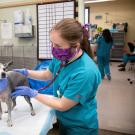
Scruffles, a 9-year-old female Shetland sheepdog, was referred to the UC Davis veterinary hospital after her white blood cell count continued to increase. The Oncology Service performed complete blood count tests to gain a better understanding of Scruffles’ condition, as well as a test called flow cytometry, which helped determine if Scruffles was dealing with a cancer of her bone marrow (leukemia).
Orphaned kittens experience more stress than kittens cared for by their mothers, according to a new UC Davis study. Understanding the effect of being orphaned on responses to stressful events could improve their care.
So, what do a local university patron, four veterinary hospital services, a veterinary resident, a newly graduated Animal Science major, and dozens of faculty, staff, and student caregivers have in common? All of these UC Davis entities came together to save the life of a tiny kitten barely big enough to fit in your hand.
Kita, a 10-year-old female American Staffordshire terrier, began limping on her front right leg in November 2019. Shortly thereafter, she refused to walk at all. Her primary veterinarian diagnosed her with osteosarcoma in the leg. Her owners chose to have the leg amputated. Following amputation, Kita was referred to the UC Davis veterinary hospital for further recommendations on treating metastasis of the tumor.
Wildlife Officer Paul Cardoza, a game warden with the California Department of Fish and Wildlife (CDFW), refers to his partner, K-9 Kilo, as his most trusted piece of equipment. The pair have been together for 11 years. So, when Kilo, a 13-year-old male German shepherd/Belgian Malinois mix, was having trouble walking and supporting himself on his hind limbs, Cardoza sought out the specialists at the UC Davis veterinary hospital.
Prince, a 9-year-old male standard poodle, was referred to the UC Davis veterinary hospital in 2017 for further evaluation of a lump on his right hind leg. His owner reported it has been there for about a year and had not changed in size.
Heavier mixed-breed dogs have higher health risks if neutered or spayed early, according to a new study from researchers at the University of California, Davis. The study also provides guidance on best age to neuter mixed breeds by weight.
One year ago, Sunny, a 9-year-old male Labrador retriever/pit bull mix, was lethargic and hadn’t eaten in several days. His owner, David Newsom, took him to his primary veterinarian, and x-rays revealed a large mass in his abdomen. Sunny was referred to the UC Davis veterinary hospital for further evaluation.
As many local clinics are unable to provide their usual levels of care due to the COVID-19 pandemic—on top of a significant caseload growth over the past decade—the UC Davis Emergency Room is seeing more patients than ever.
In 2015, Izzie, a 6-year-old female yellow Labrador retriever, was a typical active Lab. She loved playing ball, chasing birds, and swimming. When her owners, Morgan and George Birdsong, noticed a tumor growing on her head, they immediately took her to their veterinarian. After diagnosing it as a mast cell tumor, Izzie’s primary veterinarian and a second opinion both offered palliative care as the best option, not giving her very long to live. At this point, Izzie’s tumor had grown to the size of a tennis ball.