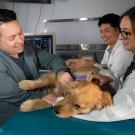
Dakota, a 9-year-old male German shepherd, was diagnosed with a mass on his kidney and was taken to see the oncology specialists at the UC Davis veterinary hospital.
Cancer can be a devastating diagnosis for any pet owner. But now, thanks to new advanced imaging equipment known as the Mini Explorer II, UC Davis veterinarians can diagnose and treat disease earlier, with greater precision.
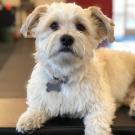
Charlie, a 2-year-old male Maltese mix, and his owner, Tyler Wilcox, were on a routine walk in their neighborhood when Charlie was severely attacked by a much larger dog. The other dog had Charlie is his mouth—shaking him violently—and was not letting go. Wilcox was forced to intervene, having to get physical with the other dog in order to save Charlie. Charlie was rushed to the nearest veterinary clinic where he was sedated and stabilized, but it was clear that his injuries were life threatening – he would need surgery within a few hours.
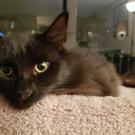
Dinx, a 10-year-old female cat, was brought to the UC Davis veterinary hospital for evaluation of a low grade soft tissue sarcoma mass on her ear that grew back after surgical removal a year prior. Most likely, another surgery would be required to remove the mass.
UC Davis veterinary cardiologist Dr. Joshua Stern led a team of researchers that has found a link between some popular grain-free, legume-rich dog diets and a type of nutritional deficiency and canine heart disease known as taurine-deficient dilated cardiomyopathy. The FDA took notice and issued warnings about the potential connection.
Rhyme, a 2-year-old male ragdoll mix cat, was being medically managed for a liver shunt for the past six months. That followed nearly two years of trying to discover the root of his illness, which seemed to have plagued him for as long as could be remembered. When a specialist in Rhyme’s hometown of Vancouver, British Columbia finally diagnosed the shunt, he recommended Dr. Bill Culp at the UC Davis veterinary hospital, who has been performing a minimally invasive procedure to correct shunts in dogs for many years. Luckily for Rhyme, Dr. Culp has also utilized this technique in cats when presented with a similar scenario.
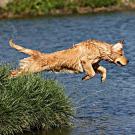
Oso, a 2-year-old chocolate Labrador retriever, started dragging his back legs while on a walk. His veterinarian in Bend, Oregon—surgeon Dr. Mauricio Dujowich, a UC Davis alum—performed an MRI that revealed a massive tumor inside his spinal cord, pinching the nerves to his back legs.
The hospital is currently in the process of implementing a modern, sustainable Picture Archiving and Communication System (PACS) that provides cutting-edge clinical, teaching, and research imaging functions for clinicians, students, faculty, staff, referring veterinarians, and clients. The hospital’s current PACS is aging and does not allow clinicians to utilize it to the best of its abilities.
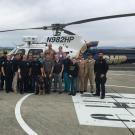
Earlier this year, K9 Officer Cort of the Fairfield (CA) Police Department was stabbed while apprehending a suspect. California Highway Patrol (CHP) officers were on site and immediately called their air division that had a helicopter in the area. CHP flew Cort to the UC Davis airport where campus police transported him about a mile to the university’s veterinary hospital.