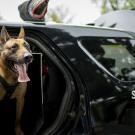
Aero, a 7-year-old German shepherd-Belgian Malinois mix, is back in action with the Anderson (CA) Police Department as a narcotics-detecting K9 officer. Four years ago, however, he was forced to prematurely retire after a mysterious illness caused his energy levels to plummet and his muscles to atrophy. His handler, Officer Mike Hallagran, did not think Aero would survive.
Bobby, a 12-year-old male miniature Schnauzer, developed cataracts in both eyes, presumably brought on by his diabetes. While he could still sense light in his eyes, the cataracts clouded his vision to the point of essential blindness. Navigation of his home was accomplished by memory and by utilizing a heightened sense of feel, especially on the staircase.
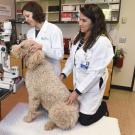
It’s fitting that Dr. Sara Thomasy is an ophthalmologist. Her eyes light up when she talks about the breakthroughs being made at UC Davis thanks to recent acquisitions of state-of-the-art imaging equipment. Eight new pieces of imaging equipment and one new piece of laboratory technology, made possible by grants from the Center for Companion Animal Health, now allow the Ophthalmology Service to provide new levels of care.
Dr. Karen Vernau has been named the recipient of the 2019 Bustad Companion Animal Veterinarian of the Year Award by the American Veterinary Medical Association (AVMA).
Researchers at the University of California, Davis, recently investigated levels of methylmercury in a small sampling of commercial dog foods and found good news for dog owners.
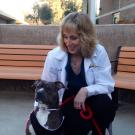
Rally, a 1-year-old female Labrador retriever, was accidentally shot while on a hunting excursion, with both of her eyes sustaining major trauma. She was referred her to the Ophthalmology Service at the UC Davis veterinary hospital who helped save her vision.
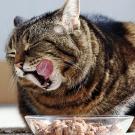
Thirty percent of cat owners surveyed use food puzzles, according to a new study led by researchers at the University of California, Davis. The puzzles benefit domestic cats by bringing out their natural foraging behavior.
A new study found a link between some popular grain-free dog foods, with a high content of legumes, and canine heart disease called dilated cardiomyopathy (DCM). The disease can lead to sudden death in dogs.