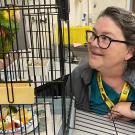
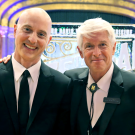
Two members of the UC Davis veterinary hospital's Companion Exotic Animal Medicine and Surgery Service were recipients of awards at the recent 45th Annual Association of Avian Veterinarians Conference and Expo.
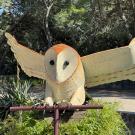
What was once a massive pepper tree at the entrance of the California Raptor Center—felled because of a storm in recent years—has been replaced by a statue of a majestic barn owl named “Pepper.”
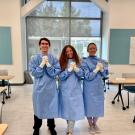
UC Davis undergrads have an opportunity to prepare for applying to veterinary school with the help of the Vet Aide Club—a student-run club with a long history of preparing its members to be competitive in animal care fields through hands-on experience, mentorship, and guidance.
UC Davis mourns the loss of Pint, a Nova Scotia Duck Tolling Retriever who captured the hearts of Aggies for over a decade. Pint passed away on May 19 at the age of 14 ½ years from metastatic lung cancer.
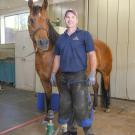
We have all heard the saying “No hoof, no horse.” Hoof care is a vital part of ensuring horse health, but the best ways to keep hooves healthy are often hotly debated. We worked with UC Davis veterinary hospital farrier Shane Westman, APF-I, to share ten things you might not know about horse hooves.
Dreams do come true at the UC Davis School of Veterinary Medicine, as witnessed at the 75th Anniversary Gala on Saturday, June 29, at the Sacramento Memorial Auditorium.
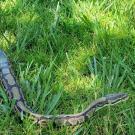
Monty, a 9-year-old male ball python, has been with owner Teena Fultz for five years. Already dubbed Monty when she received him, the snake got to keep his famous moniker as Fultz appreciated the humor behind it. They have been constant companions since.
Past and present members of the UC Davis School of Veterinary Medicine were among the award winners at the 2024 American College of Veterinary Internal Medicine Forum, held recently in Minneapolis.
We mourn the passing of Dr. Roy Bellhorn, an avid educator, clinician, researcher, philanthropist, volunteer and chorister. He was a kind man with a gentle sense of humor, and will be missed by his colleagues, friends, and family.
Team members from the veterinary school community took home the $12,500 Animal Health Award from the 24th annual Big Bang! Business Competition on Tuesday, May 21. Their collaboration, known as Equine Teaching Innovations, created a silicone injection pad that enables student animal health professionals to learn basic injection skills in a life-like way without injecting a live animal.
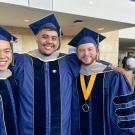
Congratulations to the Class of 2024 who received their degrees from the UC Davis School of Veterinary Medicine in its 74th Commencement Ceremony held at the Mondavi Center on May 24th. Among those graduating were 145 DVM students, 31 residents and 17 students in the Master of Preventive Veterinary Medicine program.
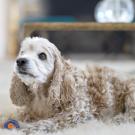
Dr. Allison O'Donnell is familiar with the UC Davis veterinary hospital, having received her veterinary degree from the school in 2023. Unfortunately, she and fiancé Matt Cardinale had to experience the hospital as clients recently when their dog Squid, a 5-year-old female husky/terrier mix, was trapped in a house fire and suffered carbon monoxide poisoning.
Dr. Sam Barringer (DVM ’91) was named the 2023 Consultant of the Year by the Academy of Veterinary Consultants (AVC), a national organization of livestock practitioners who provide high quality continuing education on topics related to livestock health.